Glossary

blackworkblackwork

Blackwork is a highly detailed form of embroidery that makes use of small, repeatable stitches that give the illusion of grays and shading by working only in black thread and making use of negative space. It has a look, technique and style all its own that is wonderful and fascinating to explore.

candlewickingcandlewicking

I bet your grandmother had a nubby bedspread like this. Candlewicking is a traditional form of embroidery begun by American pioneer women who didn’t have finery like silks to stitch with and were left with only the barest of materials: candlewicking and simple cottons. Most often worked in white on white, the primary stitches are Colonial Knot (aka the Figure Eight knot) and an outlining stitch of choice.

crewel

Crewel is traditional British embroidery dating back nearly eight hundred years. This type of embroidery is stitched on linen with two-ply twisted wool in elaborate stitches that fill, rather than just outline, the design. Because of the thickness of the yarn and the solidly worked stitches, the design really stands up from the fabric giving it a varied and wooly texture. Crewel enjoyed a revival in the 70’s and most often displays floral, Jacobean-style organic motifs. Little seems to be known about the origin of the word ‘crewel’. Some sources claim it comes from an ancient word for ‘curl’, referring to the curl of the wool fibers.

cross stitch

Cross stitch is simply an embroidery stitch of an x. Cross-stitch can be worked with or without respect to the weave of a fabric. If a chart is followed, or the weave of the fabric governs the placement of the stitches, then it’s counted cross stitch. Usually a blunt-tipped needle is used (a tapestry needle), to more easily pass through the openings of the fabric’s weave, not the fibers themselves.

embroideryembroidery

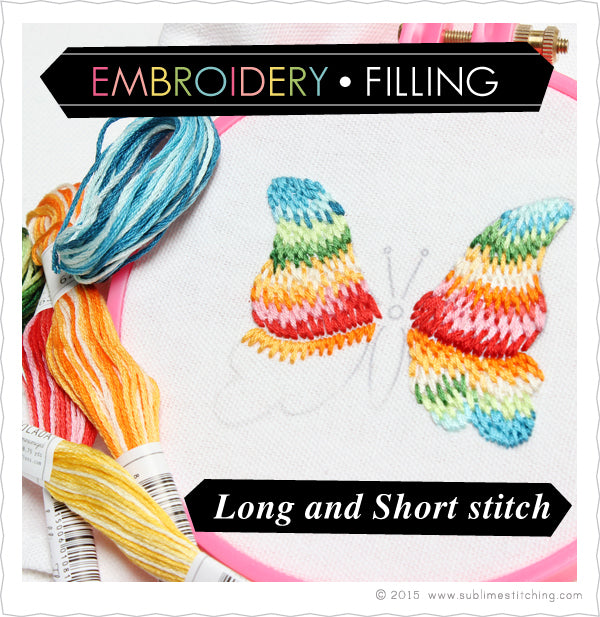
Embroidery can be so, so many things. This is the alpha term for most of the decorative needlearts. ‘Embroidery’ just means any kind of decorative stitching, which can include an endless variety of styles. If you make decorative stitches on fabric, you’re embroidering. You can work in any media on any surface in a free-form manner, along a pattern, or simply by repeating a stitch along a hem or cuff, or edge of a tablecloth. There are endless combinations of stitches and possibilities. Sublime Stitching patterns are designed for embroidery but can be used as templates for other kinds of embroidery as well. Other types of embroidery make use of specific tools and materials, and then earn new and unique names.

hardanger

to come

needlepointneedlepoint

Needlepoint often gets casually referred to as ‘tapestry’. Close your eyes, and think of those pixelated-looking floral cushions on old chairs and ottomans. That’s our good buddy, needlepoint. Instead of working on a surface, the needlepoint becomes the surface. It’s only stitched in one embroidery stitch, the ‘Tent Stitch’, worked over and over again in yarn with a large, blunt needle on a canvas with a wide open weave. The design is already present on the canvas, so the needlepointer simply works the yarn colors to match the colors painted on the canvas without needing to count or consult a chart. Needlepoint can be a relatively expensive hobby since many needlepoint canvases are hand-painted and artists charge accordingly for their handwork.

punch-needle embroiderypunch-needle embroidery

Punch-needle embroidery makes use of a hollow needle that drags and loops the floss in and out of the ground fabric, leaving a trail of looped stitches. Designs are worked solidly, leaving a little plush texture, like a tiny rug. Also called "igolochkoy", punch-needle is a traditional Russian (Design worked by Ginger Edwards.)

redworkredwork

Redwork is stitched entirely in red outline on a white or ivory ground. The motifs tend to be more illustrative (think Victorian children and bonneted girls) and are popularly used on quilts. The limited use of decorative stitches or need for color choices makes this an excellent type of embroidery for beginners.

ribbon embroidery

Ribbon embroidery is worked with, that's right: ribbon. The result is gorgeously sculptural, and makes wonderful roses and floral sprays.

tapestrytapestry

Tapestry is really more akin to weaving, rather than stitching. Think of large wall-hangings of elaborate floral displays or historic scenes of high romance and drama. Once labored over by nuns for years at a time, tapestries are most often associated with medieval times, as tapestries served the dual purpose of decorating and insulating the stone walls of castles. Nowadays you can find repro tapestries that are machine-made to be used as throw blankets and wall-hangings.


Sublime Stitching ®
This ain't your gramma's embroidery!™
PO Box 15130, Austin, TX 78761

site and content © 2001 - 2010
All rights reserved.
Privacy Policy and Terms of Use.

Footer menu links

Visa, MasterCard, Discover, AMEX, eCheck, PayPal accepted
Orders by mail gladly accepted!